
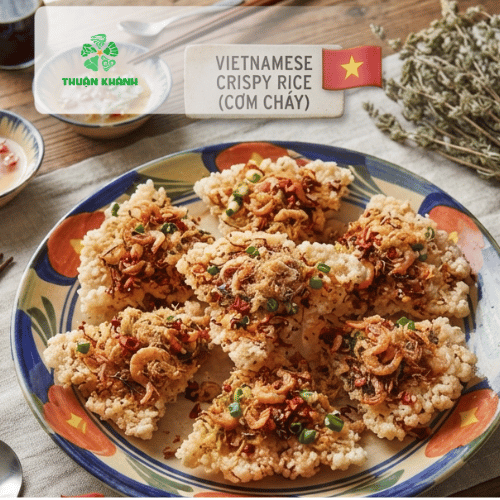
Wondering how Vietnamese crispy rice differs from Japanese senbei? Grab a coffee and check out this fun, simple guide comparing ingredients, textures, and flavors!
Quick Comparison: Vietnamese Crispy Rice vs Japanese Rice Crackers
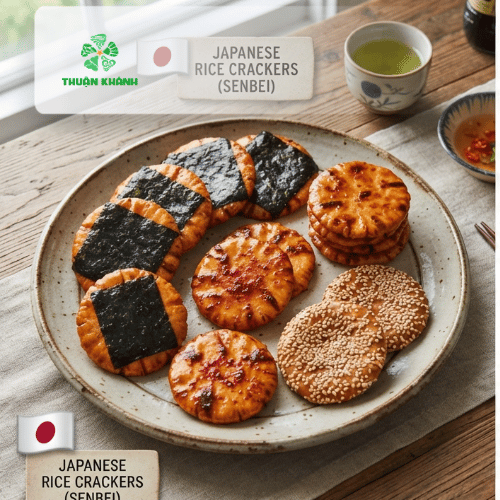
| Feature | Vietnamese Crispy Rice (Cơm Cháy) | Japanese Rice Crackers (Senbei) |
| Base Ingredient | Made from cooked rice | Made from rice flour or pounded rice |
| Cooking Method | Deep-fried or baked | Mostly baked or grilled |
| Texture | Thick, airy, crispy | Thin, hard, crunchy |
| Toppings / Seasoning | Served with savory toppings | Usually plain or lightly seasoned |
| Cultural Context | Street food & artisan snack | Traditional Japanese tea snack |
| Popularity | Popular in Vietnam (and worldwide) | Popular in Japan |
-
What Is Vietnamese Crispy Rice?
When we talk about what is Vietnamese crispy rice, it is actually made from real, fully cooked rice grains. People dry them out and then fry or bake them until they turn golden and super crispy.
The best part? Because it doesn’t get ground down into a fine flour, when you take a bite, you can still see and feel individual rice grains clustered together, giving it an amazing, airy crunch. Popular variations like pork floss rice crackers and fish sauce rice crackers take the flavor profile to a whole new level:
- Pork floss (chà bông)
- Chicken floss
- Savory fish sauce glaze & scallion oil
- Chili sauce
- Dried shrimp
Among these, the absolute crowd-favorite is Cơm Cháy with pork floss—a legendary crispy rice snack from Vietnam that has taken the global market by storm.
-
What Are Japanese Rice Crackers?
Now, crossing over to our neighbors in Japan, Japanese rice crackers (commonly called Senbei) follow a completely different manufacturing process.
Instead of using whole cooked rice grains, they use rice flour or a pounded rice dough, press it into thin sheets or shapes, and grill or bake them over heat. Their flavors tend to be much more subtle and delicate:
- Soy sauce
- Seaweed (nori)
- Sesame
- A light sweet glaze
- Salt
The texture is firm, snap-like, and dry, rather than the thick, puffy, and airy crunch you get with Vietnamese crispy rice crackers.
-
Production Process
Just looking at how they are made shows you two completely different culinary worlds:
Vietnamese Crispy Rice
- Cook premium rice into actual grains
- Form into uniform rice cakes or sheets
- Dry naturally or using industrial dryers
- Fry or bake until puffed and golden
- Coat with a signature savory fish sauce reduction
- Generously top with pork floss and scallion oil
Japanese Rice Crackers
- Grind rice into flour or prepare a smooth rice dough
- Shape into thin, flat crackers
- Bake or grill until rigid
- Brush with soy sauce or sweet glaze
- Dry thoroughly and package
-
Texture Comparison
How they feel when you sink your teeth into them:
- Vietnamese crispy rice is: Puffy, crispy, airy, rich, and features a satisfying bite where the individual rice grains keep a wonderful texture.
- Japanese rice crackers are: Dense, thin, dry, hard, and evenly toasted throughout.
-
Flavor Profile
- Vietnamese Crispy Rice: Bold, punchy umami flavors driven by fish sauce, pork floss, scallion oil, garlic, and chili.
- Japanese Rice Crackers: Milder, cleaner flavors such as soy sauce, seaweed, sesame, sugar, or simple salt.
-
Which One Is Better?
There’s no objective winner here—it totally depends on what your cravings are telling you:
- Choose Vietnamese crispy rice if you enjoy: Big, bold, savory flavors, heavy toppings loaded with protein, and an irresistible street food crunch.
- Choose Japanese rice crackers if you prefer: Light, subtle seasoning, toasted grain notes, and a simple snack to pair with afternoon tea.
How Vietnamese Crispy Rice Is Made
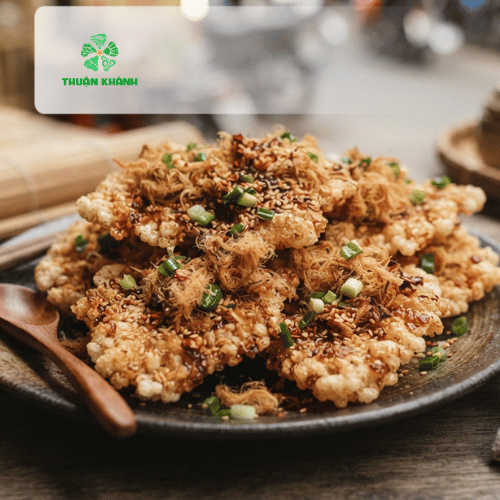
One of the biggest differences between Vietnamese crispy rice and Japanese rice crackers lies in the manufacturing process.
At a Vietnamese rice cracker factory, the snack begins with premium cooked rice, not rice flour. The cooked rice is pressed into round or rectangular cakes, then dried until the moisture level is suitable for frying or baking. This step is essential for creating the signature crispy texture while keeping the rice grains intact.
Once dried, the rice cakes are fried or baked until they become golden, light, and airy. Depending on the product, manufacturers may add a layer of fish sauce glaze, scallion oil, pork floss, chicken floss, dried shrimp, or other savory toppings.
For export markets, manufacturers can also produce plain crispy rice bases without toppings, allowing importers or private label brands to season the products according to local consumer preferences.
This production method is what gives Vietnamese crispy rice its unique appearance and texture—crispy on the outside while preserving the shape of individual rice grains.
Why Importers Choose Vietnamese Crispy Rice
As global demand for Asian snacks continues to grow, Vietnamese crispy rice has become an increasingly popular product among importers, distributors, and private label food brands.
Compared with many conventional rice crackers, Vietnamese crispy rice offers several advantages:
- Authentic Vietnamese flavor that stands out in international markets.
- Multiple product options, including fish sauce, pork floss, brown rice, spicy, cheese, and plain varieties.
- Flexible OEM and private label manufacturing services.
- Stable production capacity for wholesale and export orders.
- Custom packaging designed for supermarkets, retail chains, and online marketplaces.
Many international buyers also choose plain crispy rice products so they can develop their own signature seasonings or adapt flavors to local tastes.
For businesses looking to expand their snack portfolio, partnering with an experienced Vietnamese rice cracker manufacturer ensures consistent quality, export-ready documentation, and reliable long-term supply.
Why Many Foreigners Get Confused
Many English websites translate Cơm cháy simply as a “rice cracker.” While it’s technically correct in the broadest dictionary sense, it doesn’t even begin to capture what the snack is actually like.
In reality:
- Vietnamese crispy rice is crafted from whole cooked rice grains and slathered in delicious toppings like pork floss, scallion oil, and fish sauce.
- When looking at Vietnamese rice cracker vs senbei, people often compare a hearty, topped artisan treat with a flat, baked snack. A direct look at Senbei vs Vietnamese rice crackers or Vietnamese crispy rice vs Japanese rice crackers shows that even though they both start with rice, their styles, textures, and flavor journeys are worlds apart.
Honestly, analyzing all of this over a cup of coffee makes me want to grab a pack of crispy rice right now!



 VI
VI  EN
EN